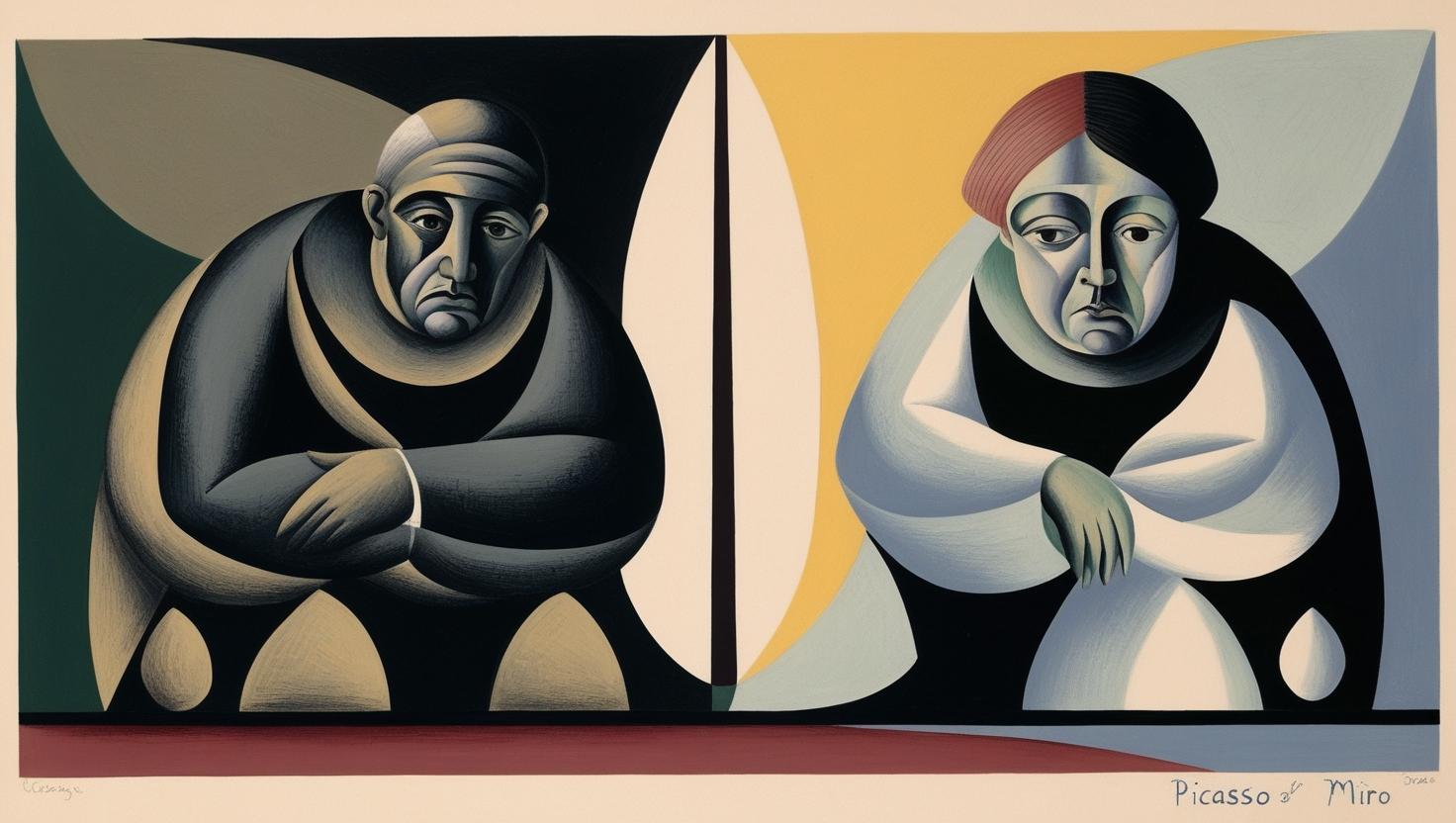
The belief only benefits our delusion of heroic individualism.
(Originally published in Medium)
Picture this: Standing before my second-year Business students, I’m dissecting a narrative as old as management theory. “Leaders see the forest, managers see the trees,” I’d declare — a perfect, neat little box that felt…wrong.
How so, you asked?
Because my experience, and most likely yours, contradicts this simplistic view. We’ve witnessed brilliant visionaries, the supposed “leaders,” who struggled to manage a team lunch, let alone a complex project. Conversely, we’ve seen meticulous managers, masters of operational details, who failed to inspire a single soul. Something doesn’t add up with the “forest vs. trees.”
The Origin of a Flawed Concept
How did we arrive at this metaphor? Doesn’t it feel like a lazy taxonomy that diminishes the complexity of human leadership? Worst, it eerily echoes outdated, reductive thinking like “women’s place is in the kitchen.” BOO…!
Like theoretical physicists who relentlessly search for the fundamental truth of our universe, I set out to understand how we created this mythical divide between leaders and managers. This divide seems to serve nothing else except our collective delusion of heroic individualism—the one who will lead us to our victory.
My research took me to Abraham Zaleznik’s 1977 article in Harvard Business Review, “Managers and Leaders: Are They Different?” (See also here.) His argument was seductive in its simplicity. For Zaleznik, leaders and managers are two distinct people. He likened leaders to artists, scientists, and other creative thinkers, contrasting them with the more pragmatic and order-oriented managers. And so began the era of the prevailing leadership-management dichotomy, with various other business scholars jumping on the bandwagon.
Harry Gray’s 1984 Wall Street Journal piece was the ultimate management takedown, I thought. (See an excerpt here.) ‘Let’s Get Rid of Management,’ he dramatically declared, as if managers were some bureaucratic plague waiting to infect the pristine world of leadership. Can you imagine? Wiping out the very folks who make organizations run?
The perpetuation of this idea romanticises leaders while marginalising managers. The titles synonymous with leaders, i.e. “Chief of” or “Director,” and with non-leaders, i.e. well…Managers, are the start of who gets the benefits. For example, this survey shows a strong preference for leaders over managers. The results also highlighted that leadership activities are viewed more positively than managerial ones. What’s next?

Individuals with ‘leader’ titles might likely enjoy the freedom to explore new horizons and receive accolades for everything they do. In contrast, those in managerial roles may feel caged (like the image above portrays), and their potential to grow stunted. Moreover, this perception that puts leaders on a pedestal may discourage individuals from pursuing managerial roles. Imagine the impact on organizations!
(Wouldn’t the forest be in trouble if there were no trees? Thought I ask…)
What Nature Reveals about Leadership
What if we could reverse the impact of romanticising leaders by rejecting the dichotomy of leaders vs. managers? Or…, imagine what would happen if Zaleznik, Gray, and others wrote about leadership by considering our nature.
Look at the animal group—wolf packs, bird flocks, even bee colonies—there’s always a leader guiding the collective. Our hunter-and-gatherer ancestors and traditional societies have leaders coordinating the groups to survive: where to hunt or gather food, how to keep the peace, and so on. The defining characteristic? Influence—the ability to guide others toward a common goal.
Nature doesn’t distinguish between its “strategic” and “operational” leaders. Tribal communities don’t have separate people for inspiration and execution. They have leaders. Adaptable. Complex. Period.
History and comparative studies show that leadership is universal and not unique to the corporate world.
The Industrial Revolution’s Twist
Now, bring forth the age of machinery, our First Industrial Revolution, which transformed how we work. With the emergence of machinery and complex organisations, suddenly, guiding a group meant more than just influencing— it demanded strategic planning, resource management, and operational precision. As you know, these are the core management functions.
The bigger the organisation and the more complex the products or services, the greater the demand for one leader to manage their workload. So, specific organisational roles were created for a more effective labour division. We’ve got the C-suite, directors, managers, team leaders, etc., a corporate structure. As the First Industrial Revolution brought forth its unintended consequence, this emergence of specialised roles may inadvertently contribute to our perception of leadership and management as distinct and separate entities.
Acknowledging leadership’s evolution in response to changing work demands is crucial to overcoming the limitations of the flawed dichotomy. Within this context, management is not a new capability (that just popped up out of thin air); it is leadership adapting. The notion that leadership differs from management, while true, only speaks about the tasks involved, not the person. It’s not about two separate individuals, as Zaleznik suggested. Let alone getting rid of management!
Breaking Free from the Myth
We’ve been trapped in a narrative that separates leaders and managers when we should be integrating. By dismantling this artificial divide and recognising the interconnectedness of leadership and management, we can unlock the full potential of every individual within an organization.
Imagine a workplace where those in C-suite roles embrace effective management and those in management roles cultivate inspiring leadership qualities. By breaking down the artificial barriers between leadership and management, we can create a more agile and adaptable workforce where individuals at all levels are empowered to lead, manage, and contribute to the organization’s success.
My students now hear a different message. I start my lecture by acknowledging the existence of the dichotomy and how it came about. Then I follow with, “Nature doesn’t distinguish between its “strategic” and “operational” leaders. Tribal communities don’t have separate people for inspiration and execution. They have leaders. Adaptable. Complex. Period.”
© 2025 Anne Burlinson
Stay ahead of the curve by subscribing to gain access to our invaluable insights.